STM32 HAL: button interrupt (EXTI)
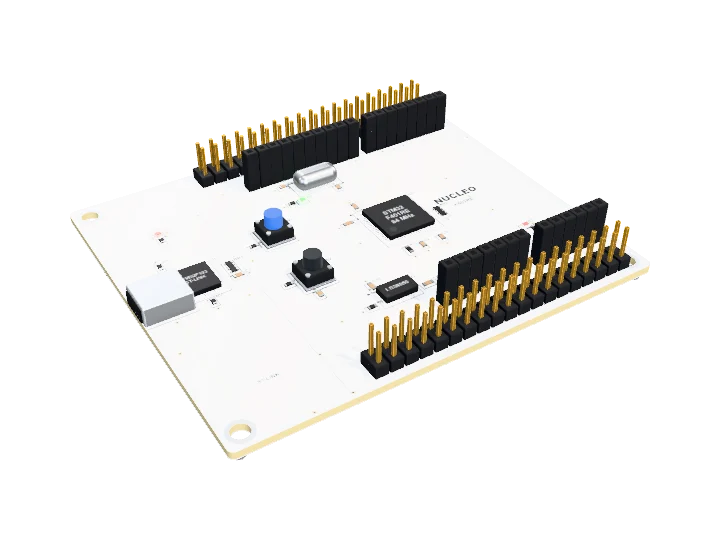
On the Nucleo-F401RE, a falling edge on D2 runs HAL_GPIO_EXTI_Callback(), which toggles LD2.
The code
/* A button's interrupt on the Nucleo-F401RE, set up as CubeMX does: PA10 (D2) is an
   EXTI line on its falling edge with the pull-up on. EXTI15_10_IRQHandler() in
   stm32f4xx_it.c hands it to the HAL, which calls HAL_GPIO_EXTI_Callback() below: it
   toggles LD2 (PA5) and counts the presses. printf goes out of USART2, the ST-LINK's
   virtual COM port. Press the button. */
#include "main.h"
#include <stdio.h>

UART_HandleTypeDef huart2;

/* USER CODE BEGIN PV */
static volatile uint32_t presses;
static volatile uint32_t last_press_ms;
/* USER CODE END PV */

void SystemClock_Config(void);
static void MX_GPIO_Init(void);
static void MX_USART2_UART_Init(void);

/* USER CODE BEGIN 0 */
int _write(int file, char *ptr, int len)
{
  (void)file;
  HAL_UART_Transmit(&huart2, (uint8_t *)ptr, (uint16_t)len, HAL_MAX_DELAY);
  return len;
}
/* USER CODE END 0 */

int main(void)
{
  HAL_Init();
  SystemClock_Config();
  MX_GPIO_Init();
  MX_USART2_UART_Init();

  /* USER CODE BEGIN 2 */
  printf("Nucleo-F401RE at %lu MHz: press the button on D2\r\n", SystemCoreClock / 1000000);
  uint32_t shown = 0;
  /* USER CODE END 2 */

  while (1)
  {
    /* USER CODE BEGIN 3 */
    if (presses != shown)
    {
      shown = presses;
      printf("press %lu, LD2 %s\r\n", shown, HAL_GPIO_ReadPin(LD2_GPIO_Port, LD2_Pin) == GPIO_PIN_SET ? "on" : "off");
    }
    HAL_Delay(10);
  }
  /* USER CODE END 3 */
}

void SystemClock_Config(void)
{
  RCC_OscInitTypeDef RCC_OscInitStruct = {0};
  RCC_ClkInitTypeDef RCC_ClkInitStruct = {0};

  __HAL_RCC_PWR_CLK_ENABLE();
  __HAL_PWR_VOLTAGESCALING_CONFIG(PWR_REGULATOR_VOLTAGE_SCALE2);

  /* HSI 16 MHz / 16 x 336 / 4 = 84 MHz */
  RCC_OscInitStruct.OscillatorType = RCC_OSCILLATORTYPE_HSI;
  RCC_OscInitStruct.HSIState = RCC_HSI_ON;
  RCC_OscInitStruct.HSICalibrationValue = RCC_HSICALIBRATION_DEFAULT;
  RCC_OscInitStruct.PLL.PLLState = RCC_PLL_ON;
  RCC_OscInitStruct.PLL.PLLSource = RCC_PLLSOURCE_HSI;
  RCC_OscInitStruct.PLL.PLLM = 16;
  RCC_OscInitStruct.PLL.PLLN = 336;
  RCC_OscInitStruct.PLL.PLLP = RCC_PLLP_DIV4;
  RCC_OscInitStruct.PLL.PLLQ = 7;
  if (HAL_RCC_OscConfig(&RCC_OscInitStruct) != HAL_OK)
  {
    Error_Handler();
  }
  RCC_ClkInitStruct.ClockType = RCC_CLOCKTYPE_HCLK | RCC_CLOCKTYPE_SYSCLK | RCC_CLOCKTYPE_PCLK1 | RCC_CLOCKTYPE_PCLK2;
  RCC_ClkInitStruct.SYSCLKSource = RCC_SYSCLKSOURCE_PLLCLK;
  RCC_ClkInitStruct.AHBCLKDivider = RCC_SYSCLK_DIV1;
  RCC_ClkInitStruct.APB1CLKDivider = RCC_HCLK_DIV2;
  RCC_ClkInitStruct.APB2CLKDivider = RCC_HCLK_DIV1;
  if (HAL_RCC_ClockConfig(&RCC_ClkInitStruct, FLASH_LATENCY_2) != HAL_OK)
  {
    Error_Handler();
  }
}

static void MX_USART2_UART_Init(void)
{
  huart2.Instance = USART2;
  huart2.Init.BaudRate = 115200;
  huart2.Init.WordLength = UART_WORDLENGTH_8B;
  huart2.Init.StopBits = UART_STOPBITS_1;
  huart2.Init.Parity = UART_PARITY_NONE;
  huart2.Init.Mode = UART_MODE_TX_RX;
  huart2.Init.HwFlowCtl = UART_HWCONTROL_NONE;
  huart2.Init.OverSampling = UART_OVERSAMPLING_16;
  if (HAL_UART_Init(&huart2) != HAL_OK)
  {
    Error_Handler();
  }
}

static void MX_GPIO_Init(void)
{
  GPIO_InitTypeDef GPIO_InitStruct = {0};

  __HAL_RCC_GPIOC_CLK_ENABLE();
  __HAL_RCC_GPIOH_CLK_ENABLE();
  __HAL_RCC_GPIOA_CLK_ENABLE();

  HAL_GPIO_WritePin(LD2_GPIO_Port, LD2_Pin, GPIO_PIN_RESET);

  GPIO_InitStruct.Pin = BTN_Pin;
  GPIO_InitStruct.Mode = GPIO_MODE_IT_FALLING;
  GPIO_InitStruct.Pull = GPIO_PULLUP;
  HAL_GPIO_Init(BTN_GPIO_Port, &GPIO_InitStruct);

  GPIO_InitStruct.Pin = LD2_Pin;
  GPIO_InitStruct.Mode = GPIO_MODE_OUTPUT_PP;
  GPIO_InitStruct.Pull = GPIO_NOPULL;
  GPIO_InitStruct.Speed = GPIO_SPEED_FREQ_LOW;
  HAL_GPIO_Init(LD2_GPIO_Port, &GPIO_InitStruct);

  HAL_NVIC_SetPriority(EXTI15_10_IRQn, 0, 0);
  HAL_NVIC_EnableIRQ(EXTI15_10_IRQn);
}

/* USER CODE BEGIN 4 */
void HAL_GPIO_EXTI_Callback(uint16_t GPIO_Pin)
{
  if (GPIO_Pin != BTN_Pin) return;
  uint32_t now = HAL_GetTick();
  if (now - last_press_ms < 50) return; /* the contacts bouncing */
  last_press_ms = now;
  presses++;
  HAL_GPIO_TogglePin(LD2_GPIO_Port, LD2_Pin);
}
/* USER CODE END 4 */

void Error_Handler(void)
{
  /* USER CODE BEGIN Error_Handler_Debug */
  __disable_irq();
  while (1)
  {
  }
  /* USER CODE END Error_Handler_Debug */
}
#ifndef __MAIN_H
#define __MAIN_H

#ifdef __cplusplus
extern "C" {
#endif

#include "stm32f4xx_hal.h"

void Error_Handler(void);

/* Private defines */
#define BTN_Pin GPIO_PIN_10
#define BTN_GPIO_Port GPIOA
#define BTN_EXTI_IRQn EXTI15_10_IRQn
#define LD2_Pin GPIO_PIN_5
#define LD2_GPIO_Port GPIOA

#ifdef __cplusplus
}
#endif

#endif /* __MAIN_H */
/* Interrupt handlers: the Cortex-M's own, then the peripherals'. */
#include "main.h"
#include "stm32f4xx_it.h"

void NMI_Handler(void) { while (1) {} }
void HardFault_Handler(void) { while (1) {} }
void MemManage_Handler(void) { while (1) {} }
void BusFault_Handler(void) { while (1) {} }
void UsageFault_Handler(void) { while (1) {} }
void SVC_Handler(void) {}
void DebugMon_Handler(void) {}
void PendSV_Handler(void) {}

void SysTick_Handler(void)
{
  HAL_IncTick();
}

void EXTI15_10_IRQHandler(void)
{
  HAL_GPIO_EXTI_IRQHandler(BTN_Pin);
}
#ifndef __STM32F4xx_IT_H
#define __STM32F4xx_IT_H

void NMI_Handler(void);
void HardFault_Handler(void);
void SysTick_Handler(void);
void EXTI15_10_IRQHandler(void);

#endif
/* Each peripheral's pins and clocks, as CubeMX writes them. */
#include "main.h"

void HAL_MspInit(void)
{
  __HAL_RCC_SYSCFG_CLK_ENABLE();
  __HAL_RCC_PWR_CLK_ENABLE();
}

void HAL_UART_MspInit(UART_HandleTypeDef *huart)
{
  GPIO_InitTypeDef GPIO_InitStruct = {0};
  if (huart->Instance == USART2)
  {
    __HAL_RCC_USART2_CLK_ENABLE();
    __HAL_RCC_GPIOA_CLK_ENABLE();
    /* PA2 USART2_TX, PA3 USART2_RX */
    GPIO_InitStruct.Pin = GPIO_PIN_2 | GPIO_PIN_3;
    GPIO_InitStruct.Mode = GPIO_MODE_AF_PP;
    GPIO_InitStruct.Pull = GPIO_NOPULL;
    GPIO_InitStruct.Speed = GPIO_SPEED_FREQ_VERY_HIGH;
    GPIO_InitStruct.Alternate = GPIO_AF7_USART2;
    HAL_GPIO_Init(GPIOA, &GPIO_InitStruct);
  }
}
More like this
STM32 HAL: blink and printf, CubeIDE layout
A CubeIDE project for the Blue Pill: 72 MHz from the crystal, PC13 blinking, printf out of USART1.
STM32CubeSTM32 Blue Pill
STM32 HAL: pot to PWM (ADC and TIM2)
On the Nucleo-L476RG, ADC1 reads a pot on A0 and TIM2’s PWM sets LD2’s brightness to match.
STM32CubeSTM32 Nucleo-L476RG
STM32 registers: blink with CMSIS, no HAL
Bare-metal register code on the Blue Pill: the PLL to 72 MHz, SysTick, GPIOC->BSRR and USART1->DR.
STM32CubeSTM32 Blue Pill